Company Description
Shimadzu Scientific Instruments (SSI) is the North American subsidiary of Shimadzu Corp., headquartered in Kyoto, Japan. SSI was established in 1975 to provide analytical solutions to a wide range of laboratories in the Americas. With a vast installed base and preferred vendor status at many institutions, SSI's instruments are used by top researchers across the globe, customers who can count on the stability, experience, and support only Shimadzu offers.
Chief Spectroscopic Techniques Supported
Markets Served
Shimadzu offers more spectroscopy instrumentation, with more software and accessory options, than any other company. This flexibility enables spectroscopists in virtually any laboratory, from biotechnology, pharmaceutical, and industrial to academic, forensic, and environmental, to select the instrument best suited to their application. Shimadzu provides free technical support for the life of the instruments and encourages customer alliances to further product development.
Major Products/Services
UV-vis: Shimadzu has been developing UV-vis spectrophotometers for over 60 years, and continues to manufacture instruments that meet scientists' needs for ruggedness, ease of use, validation, and applications. Key instruments include the micro-volume BioSpec-nano, compact, high-resolution UV-1800, high-performance UV-2600/2700, and three-detector UV-3600/3700.
FT-IR: From research to routine tasks, our systems, including the new high-speed, high-sensitivity IRTracer-100, deliver stable, reliable, high-precision infrared analysis for a wide range of applications.
Fluorescence: High-performance spectrofluorophotometer handles a range of applications from routine analysis to high level R&D.
AA/ICP: Simultaneous ICP and our series of high-quality AA spectrometers offer superior reliability, precision, sensitivity, and throughput to deliver maximum performance and value.
X-ray: Our EDX/XRF/XRD systems are packed with powerful features to provide users with versatile, easy-to-use solutions.
Facility
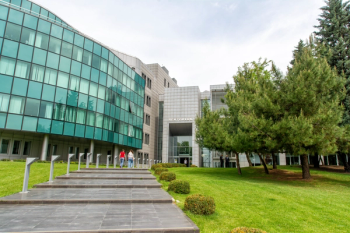
Shimadzu's US headquarters includes customer service and technical support, as well as a customer training and education center and a new solution center to showcase technologies and provide space for more collaborative research. Shimadzu's 10 regional facilities, strategically located around the US, provide customers with local sales, service, and technical support.
Shimadzu Scientific Instruments
7102 Riverwood Drive
Columbia, MD 21046
TELEPHONE
(800) 477-1227
(410) 381-1227
FAX
(410) 381-1222
E-MAIL[email protected]
WEB SITEwww.ssi.shimadzu.com
NUMBER OF EMPLOYEES
US: 370
Worldwide: 10,600
YEAR FOUNDED
Shimadzu Scientific
Instruments: 1975
Shimadzu Corporation: 1875